

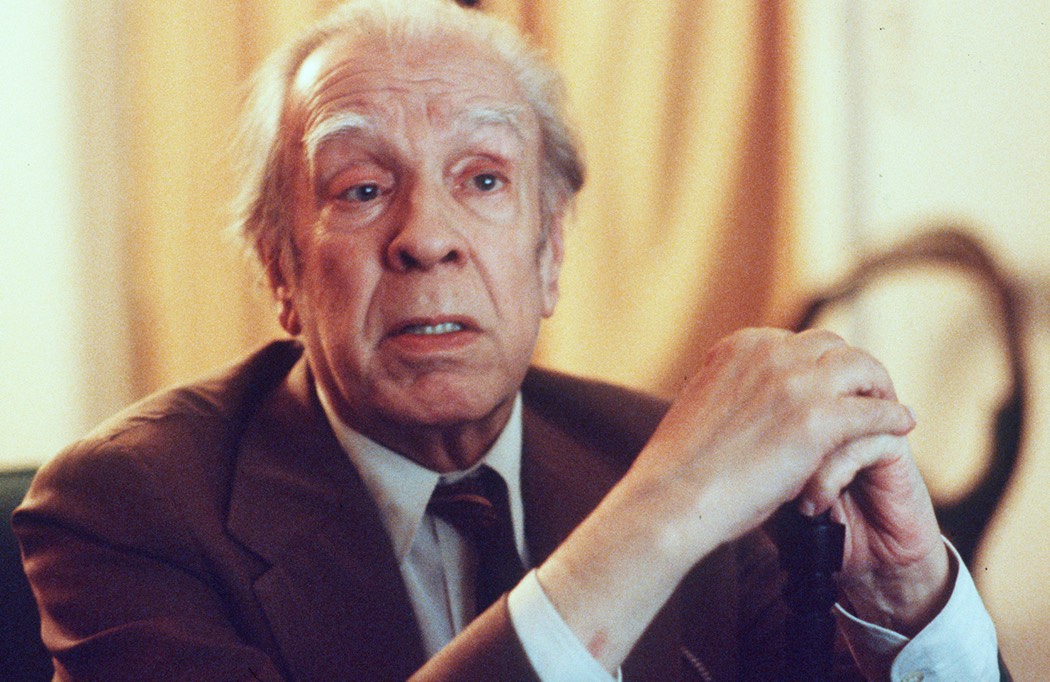
Jorge Francisco Isidoro Luis Borges Acevedo (1899-1986) was an Argentine short-story writer, essayist, poet, and translator. One of the most significant literary figures of the 20th century, Borges is best known for his intricate, philosophical stories that often deal with labyrinths, mirrors, infinity, and the nature of time.
Early Life and Background:
- Birth and Family: Born in Buenos Aires on August 24, 1899, Borges hailed from a family with a rich cultural background. His father, Jorge Guillermo Borges Haslam, was a writer and a teacher, and his mother, Leonor Acevedo Suárez, was a descendant of notable Argentinian figures.
- Education: In 1914, the Borges family moved to Geneva due to the outbreak of World War I. Borges graduated from high school in Geneva and later studied at the University of Geneva. After World War I ended, the family lived for a time in Spain.
- Return to Argentina: Borges returned to Buenos Aires in 1921. The vibrant city with its blend of European and local cultures greatly influenced his works.
Literary Career:
- Early Works: Borges started publishing his poems and essays in surrealist literary journals in the 1920s. His first book of poetry, “Fervor de Buenos Aires,” was published in 1923.
- Prose and Short Stories: Borges is perhaps most celebrated for his short stories. Collections such as “Ficciones” (1944) and “El Aleph” (1949) are seminal works in the world of literary fiction. Stories like “The Garden of Forking Paths” and “The Library of Babel” exemplify his unique style and themes.
- Later Works and Blindness: By the late 1950s, Borges began losing his sight, eventually becoming completely blind. Despite this, or perhaps because of it, he continued to write, though he shifted more towards poetry and essays. His blindness also led him to assume the role of Director of the National Public Library in Buenos Aires.
- Themes and Style: Borges’ work often delves into philosophical topics, exploring the nature of reality, identity, and time. His style is characterized by its erudition, and he frequently references and reworks various literary and historical sources.
Legacy:
Borges’ impact on literature is profound. Many contemporary writers, both within and outside Latin America, acknowledge his influence. Despite the depth and complexity of his work, Borges never received the Nobel Prize in Literature, a notable omission often commented upon in literary circles.
Personal Life and Death:
Borges never had children and was known to have had a few romantic relationships throughout his life. He married twice, with his second wife, María Kodama, being his companion until his death.
Borges passed away in Geneva on June 14, 1986. His work, however, continues to inspire and captivate readers worldwide.
Travel and International Influence:
- Borges traveled extensively throughout his life. In the 1960s and 1970s, he delivered lectures around the world. These travels and interactions influenced his worldview and literary output.
- While known for his Spanish-language works, Borges was a polyglot, fluent in English and familiar with French, German, and Old Norse. This deep knowledge of languages allowed him to work as a translator. He translated works of writers like Edgar Allan Poe, William Faulkner, and Virginia Woolf into Spanish.
Recognition and Awards:
- Borges was widely recognized and awarded multiple times throughout his life, including receiving the Formentor Prize (shared with Samuel Beckett) in 1961 and the Cervantes Prize, the most prestigious award for Spanish-language writers, in 1980.
- His name was often suggested for the Nobel Prize in Literature, but for various reasons—possibly including his political views—he never received it.
Political Views:
- Borges’ relationship with politics was complex. Initially, he supported Argentine dictator Juan Domingo Perón but later became a staunch critic. His opposition to Peronism led to his removal from his library job in the 1940s, at which point he was “promoted” to a poultry inspector, a position he never actually assumed.
- Later in life, Borges was vocal in his criticism of totalitarian regimes and expressed controversial views about the Falklands War between Argentina and the UK in the 1980s.
Influence and Legacy:
- Borges’ influence isn’t just limited to literature. His work has inspired artists, philosophers, and filmmakers. For instance, the movie “Inception” by Christopher Nolan has elements reminiscent of Borgesian themes.
- Postmodernist writers, such as Thomas Pynchon and Salman Rushdie, have acknowledged Borges’ influence on their work.
- His style, which blends fiction with non-fiction and employs footnotes and faux bibliographies, challenged traditional narrative forms and laid the groundwork for the metafictional style that became popular in the latter half of the 20th century.
Later Life:
- Borges’ vision deteriorated due to a congenital condition that had affected many men in his family. Despite his blindness, he continued to tour, lecture, and write with the help of his mother and later his secretaries and friends.
- In his later years, Borges’ works became more introspective, with reflections on his own past and literary career.
Interests and Inspirations:
- Borges had a profound interest in philosophy, and this is reflected in his works. He often referenced and played with the ideas of philosophers like Berkeley, Schopenhauer, and Hume.
- He had an abiding fascination with labyrinths, mirrors, and the infinite. These motifs recur throughout his works, symbolizing the complexities and mysteries of the universe and human consciousness.
- Borges was deeply influenced by various literary traditions, from the mysticism of Sufi poets to the detective fiction of Edgar Allan Poe. This eclectic blend gave his works a unique universality.
Collaborations and Partnerships:
- Borges frequently collaborated with other writers. One of his frequent collaborators was Adolfo Bioy Casares, a fellow Argentine writer. Together, they wrote a series of detective stories under the pseudonym H. Bustos Domecq.
- Another significant collaborator was his personal secretary and friend, María Kodama. Originally his student, Kodama later became his assistant, helping him transcribe his works after his blindness. Their relationship evolved into a deep bond, and they married in 1986, shortly before Borges’ death.
Literary Techniques and Innovations:
- Borges was known for stories that were not just stories but reflections on the nature of narrative itself. His works often blur the line between the text and meta-text, fact and fiction.
- His use of “fictitious essays” and “pseudo-bibliographies” added layers of authenticity to his fictional universes. A great example is “Tlön, Uqbar, Orbis Tertius”, where he discusses a fictional country and its philosophy, providing extensive (and entirely invented) references.
Impact on Other Fields:
- Beyond literature, Borges’ ideas have been explored in fields like theoretical physics and mathematics, especially his musings on infinity and the universe. For instance, the “Borges’ Universe” is a term coined in mathematics, inspired by “The Library of Babel”, to describe a certain kind of infinite structure.
- Philosophers, particularly those interested in epistemology and metaphysics, often delve into Borges’ texts to explore concepts about reality, knowledge, and the nature of existence.
Later Years and Reflections:
- As Borges aged, his writings often turned to themes of memory, aging, and retrospection. He also pondered the nature of his own legacy and the immortality of the written word.
- Borges’ later poems are tinged with a melancholic beauty, capturing the essence of a man who is at peace with the mysteries of the universe, embracing the unknowable.
Despite passing away in the mid-1980s, Borges’ influence remains undiminished. His works continue to inspire new generations of writers, artists, and thinkers. His ability to transcend cultural and temporal barriers makes him a truly global figure in the realm of literature and thought.
